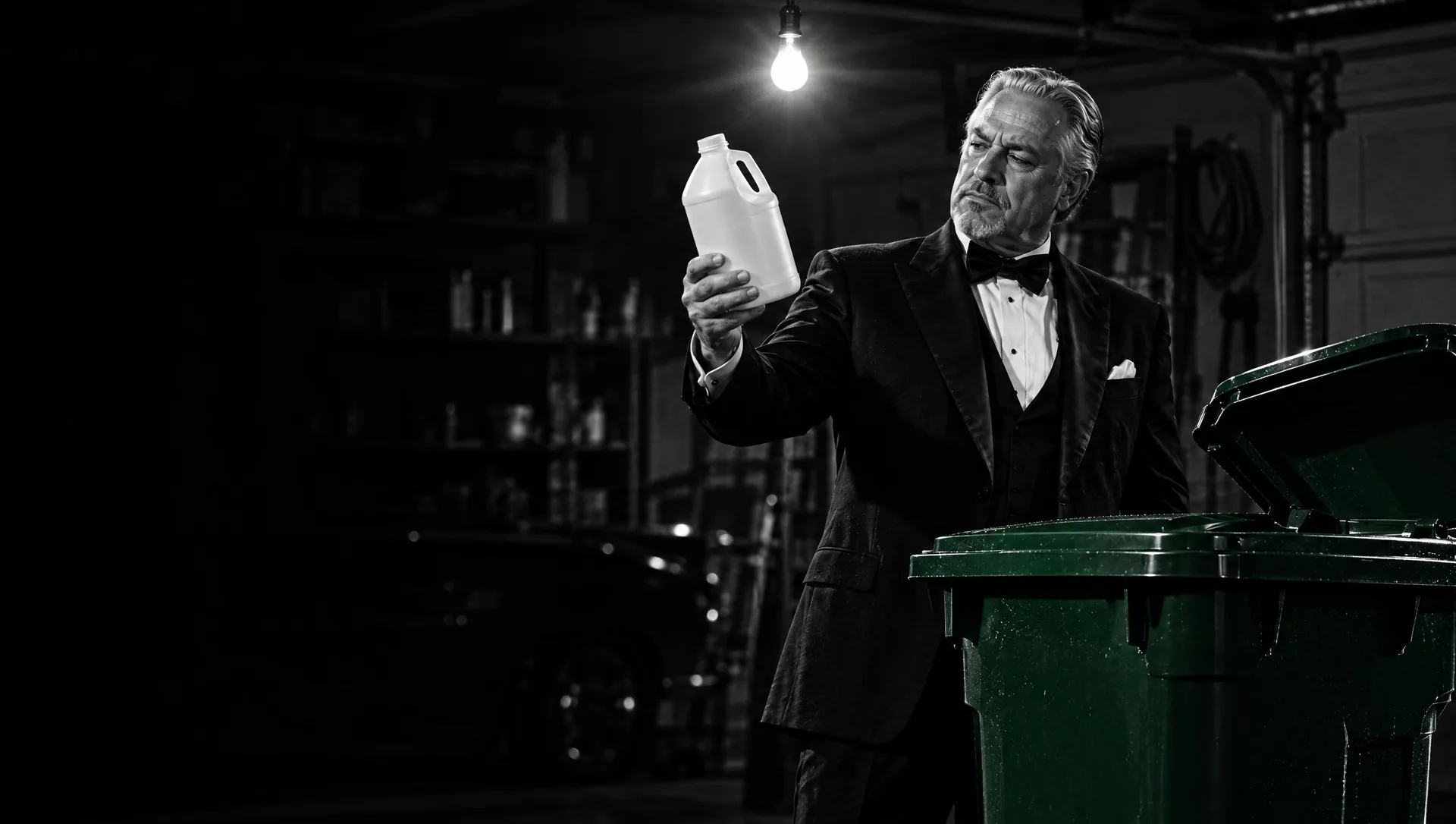
A trash bin that comes with a house you have just bought is probably still holding the last household's residue, even if it looks empty. In most South Florida programs the cart is issued to the address, so it stays when they leave. A hose will not lift years of bonded film; a hot-water, high-pressure reset will.
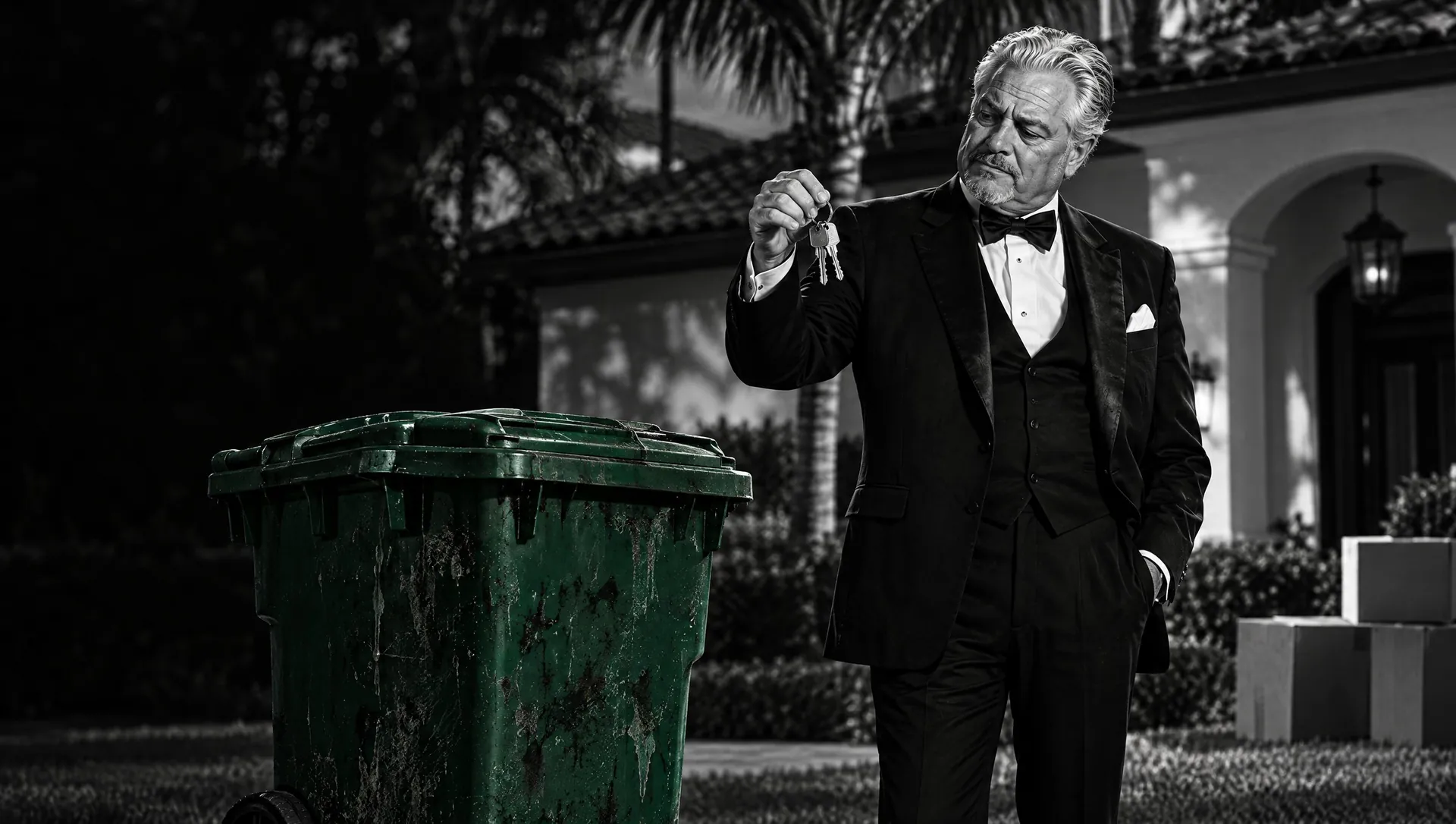
You get the keys, you walk the property, and somewhere along the side of the garage there are two carts you did not choose. Nobody mentioned them at closing. The inspector did not open them.
In most South Florida programs the cart is issued to the address rather than to the resident — worth confirming with your own city, but the practical result is the same everywhere: the bin stays when the people leave. Whatever the last household did or did not do to it for the past several years is now sitting in your side yard.
In this scene · 6 questions
How bad is an inherited bin, realistically?
How bad an inherited bin is depends on one thing: whether anyone ever cleaned it. Most people never do.
A cart that has been in service at one address for five or six years, emptied weekly and never washed, has a bonded film of organic residue on the walls, a crust around the rim, a coating on the underside of the lid and a shallow pool of liquid in the base channel that never fully dries. None of that leaves when the truck tips the bin. The truck removes bags; the film stays.
So the honest answer is that you have probably inherited every bag that ever leaked in there. The bin looks empty. It is not clean.
Why is moving week the worst time to have a dirty bin?
Because moving generates exactly the waste a dirty cart is worst at handling.
Think about what goes in during those first ten days. The contents of the old fridge, including whatever thawed in transit. Condiment jars nobody wanted to repack. The freezer drawer. On top of that, enough packing material to fill the cart fast, so the wet things sit at the bottom under everything else.
Then add the part people forget: the bin may have been sitting closed in the sun for weeks while the house was empty and nobody was putting it out. Sealed plastic, Florida heat, and whatever the last household left inside. That is not a neutral starting point — it is a head start.
What should I check on an inherited bin?
Lift the lid and look, once, properly. Five things tell you most of it — the base channel, the lid, the rim, the smell and cracks:
- 01The base channel. Tip the cart slightly and look at the floor of it. Standing liquid or a dark sludge line means residue, not a spill.
- 02The underside of the lid. This is the surface nobody ever looks at and the one that holds the most. If it is coated, the cart has never been cleaned.
- 03The rim and the lip. Crust around the lip is old and dried, which means it has been building for years.
- 04The smell, ten seconds after opening. A dirty cart does not smell when you first lift the lid — it smells once the warm air comes up out of it.
- 05Cracks, and the base especially. A cracked cart leaks into your driveway and cannot be sealed. Most programs will replace a damaged cart; ask your city before you pay anyone to clean one that needs replacing.
Can I just hose it out myself?
You can, and it will look better for an afternoon. It will not be clean.
Cold water at hose pressure moves loose debris around and drains out. It does not break the bond between a dried residue film and the plastic wall, and it does not reach the underside of the lid or the base channel with any force. That is why the smell comes back the same evening — the source was never removed, it was just rinsed past.
The other half of it is that a garden hose has nowhere to put what it does take off — it runs down your new driveway. We bring our own water and tidy the area before we leave.
What actually cleans an inherited trash bin?
Heat and pressure, on every surface, including the two nobody reaches: the underside of the lid and the base channel.
The film is organic and it is bonded. Hot water at high pressure lifts it off the plastic instead of pushing it around, and it is the only approach that does anything for the lid underside and the base channel — the two places the odour is actually manufactured. That is the whole job on a neglected cart, and it is why the first clean on an inherited bin is a different piece of work from a maintenance visit.
For a bin with years on it, start with a one-time reset: $65, covering two bins, which for most houses is the garbage cart and the recycling cart together. Each additional cart — yard waste, a second garbage bin — is $10. That is The BinFather's one-time deep clean, and it is the right first move on a cart whose history you do not know.
After that it is a maintenance question, not a rescue one. Monthly is $30 for two bins, and every 3 months is $50. The full list is on the pricing page.
When should I clean an inherited bin?
Before you unpack, not after, for two practical reasons.
The first is that the cart is empty right now, and it will not be empty again for a while. The second is that the first weeks in a house are when you decide what normal looks like there. A bin that smells from week one becomes something you stop noticing and start living with — and by the time you deal with it you have had ants in the side yard all summer.
The short version
The cart belongs to the address, so you inherited someone else's residue along with the house. The truck never washed it and neither did they. Moving week loads it with thawed fridge contents at exactly the moment it is least able to cope, and a hose will not undo years of bonded film.
One reset, $65 for both carts. Book online and we come on your collection day, after the truck has emptied the bins.