
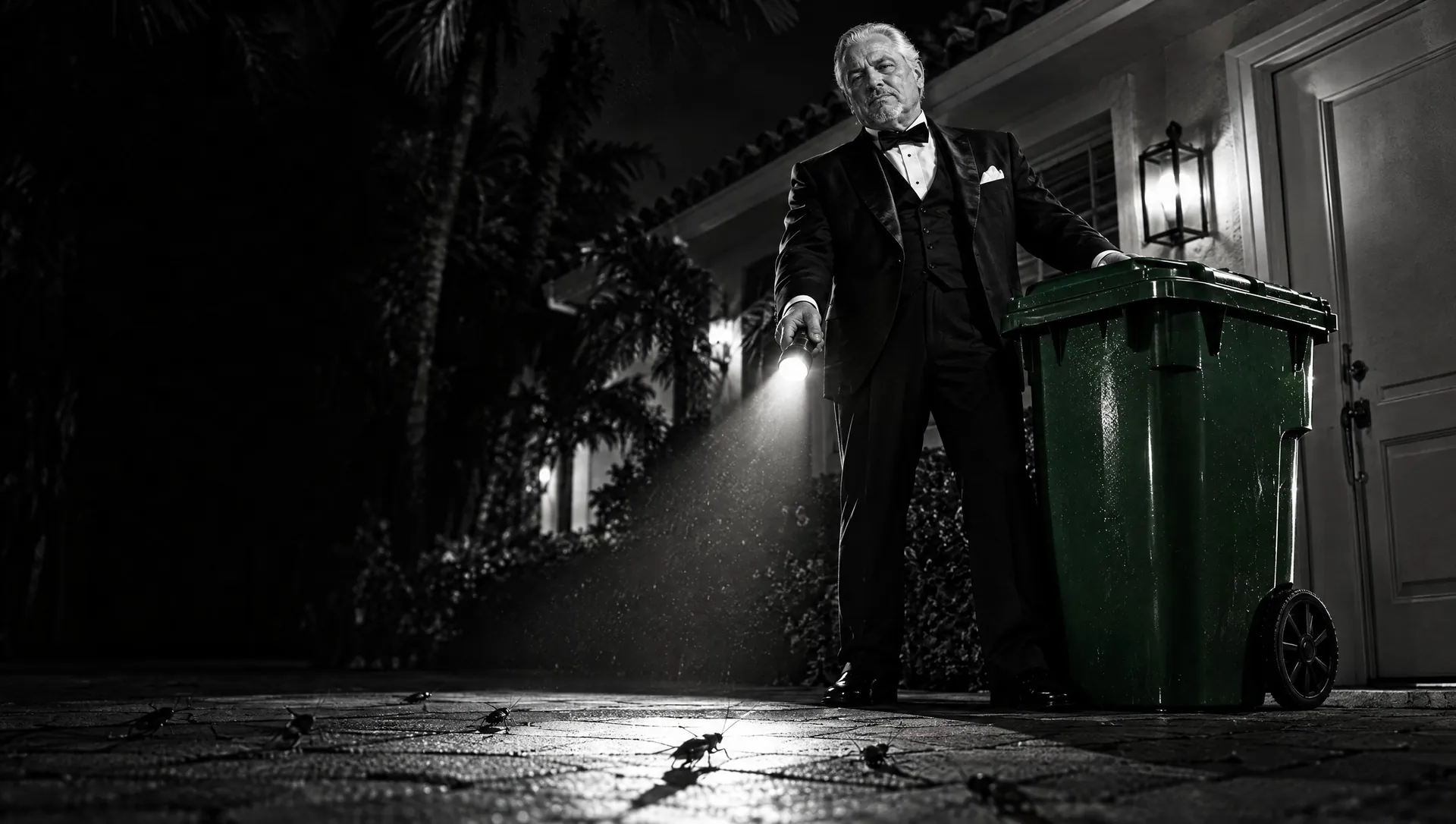
Roaches keep coming back to a trash can because the bin is where they eat, not where they live. The film of grease and sugar on the walls and the pool in the base channel are a food source that resupplies weekly, year-round in South Florida. Spraying kills the roaches present and leaves the food behind, so they return on schedule.
In this scene · 6 questions
Do roaches live in the trash can or just feed there?
Roaches feed in a trash can but do not live in it, and that distinction changes everything.
Roaches nest somewhere dark, tight and undisturbed — a wall void, under a deck, in a woodpile, in the mulch bed, behind an outdoor unit. They do not nest in your trash cart. It is too exposed, it gets tipped upside down every week, and there is nothing to hide in.
What they do is commute to it. The bin is a reliable, warm, humid food source that resupplies every seven days, and in South Florida it is one of the best ones available. Killing whoever is in the bin at the moment you look is killing the diners, not closing the restaurant.
That is why the interval before they return matches the roach's foraging cycle rather than the strength of your spray.
What do roaches eat in a trash can?
Not the bag — roaches eat the residue on the plastic.
Roaches are drawn to fats, sugars and starches, and the film bonded to the inside of an uncleaned cart is all three in a thin, accessible layer. It is more attractive to them than a sealed bag is, because it requires no work to get at.
The base channel is the concentrated version — a shallow pool of liquid and organic material that never dries out. If you have a roach problem in a bin, look at the bottom four inches first. That is where they will be.
Why don't roach sprays and bombs work on a trash can?
An outdoor trash can wears a spray off quickly and has no sealed air for a bomb to treat.
A spray treats a surface. It sits on the plastic and kills on contact for as long as the residue lasts, which in an outdoor bin exposed to rain, heat and the weekly emptying is not long.
A bomb or a fogger treats a volume of air. In a container that gets opened, emptied and turned over every week, there is no sealed volume to treat.
Bait works better but competes with the bin. Bait relies on being the most attractive food available. A cart with a film of grease and sugar on the walls is stiff competition, and you have essentially asked the roach to choose your poison over an easier meal.
Remove the film, and bait around the perimeter suddenly becomes the best food on offer. The two approaches work together — but only in that order.
Why are trash can roaches worse in South Florida?
Two things make trash can roaches worse in South Florida than almost anywhere: the palmetto bug, and no cold season.
The American cockroach — what everyone here calls a palmetto bug — is large, flies, lives outdoors by preference, and is entirely comfortable in a trash cart. It is not an indicator of a dirty house. It is an indicator of an available food source outside it.
There is no cold season to interrupt the cycle. In most of the country roach activity collapses for months. Here it runs all year, which means a bin that has never been cleaned has been feeding them continuously since the day it arrived.
How do you get rid of roaches in a trash can?
Food first, bait second:
- 01Strip the film. Heated water at high pressure breaks the bond between the residue and the plastic and carries it off — walls, base channel, rim and the underside of the lid. Cold water at hose pressure moves the top layer around and leaves the food behind.
- 02Deal with the pool at the base. Tip the cart forward after collection so the channel drains, and stop pouring liquid into the bin.
- 03Bag and double-bag. Anything wet, anything sugary, anything greasy.
- 04Latch the lid. It will not stop a determined roach but it removes the easy route.
- 05Then bait the perimeter, not the bin. Once the bin is no longer the best meal in the yard, bait near where they are actually nesting starts working properly.
- 06Look at where the bin sits. A cart against a fence, in mulch, or beside a woodpile is parked next to a nest. Moving it three metres onto open concrete is free and it helps.
Can a trash can cleaning service get rid of roaches?
Usually, but not by killing them: The BinFather is not pest control and we do not treat for insects. What we do is remove the reason roaches keep choosing your bin — and in most households that is enough on its own. If it is not, a clean bin makes an exterminator's bait far more effective than it would otherwise have been.
We clean the base channel and the lid underside as a matter of course, because those are the two places a roach problem actually lives and the two places a hose never reaches.
The short version
Roaches do not live in your bin, they eat there. Spraying kills the ones present and leaves the food supply intact, which is why they return on schedule. Remove the bonded film from the walls and the pool from the base, and the bin stops being worth the trip.
We work on your collection day, after the truck has emptied the cart, across 43 South Florida cities. A one-time clean is $65 for two bins; monthly is $30. See the prices or book online.