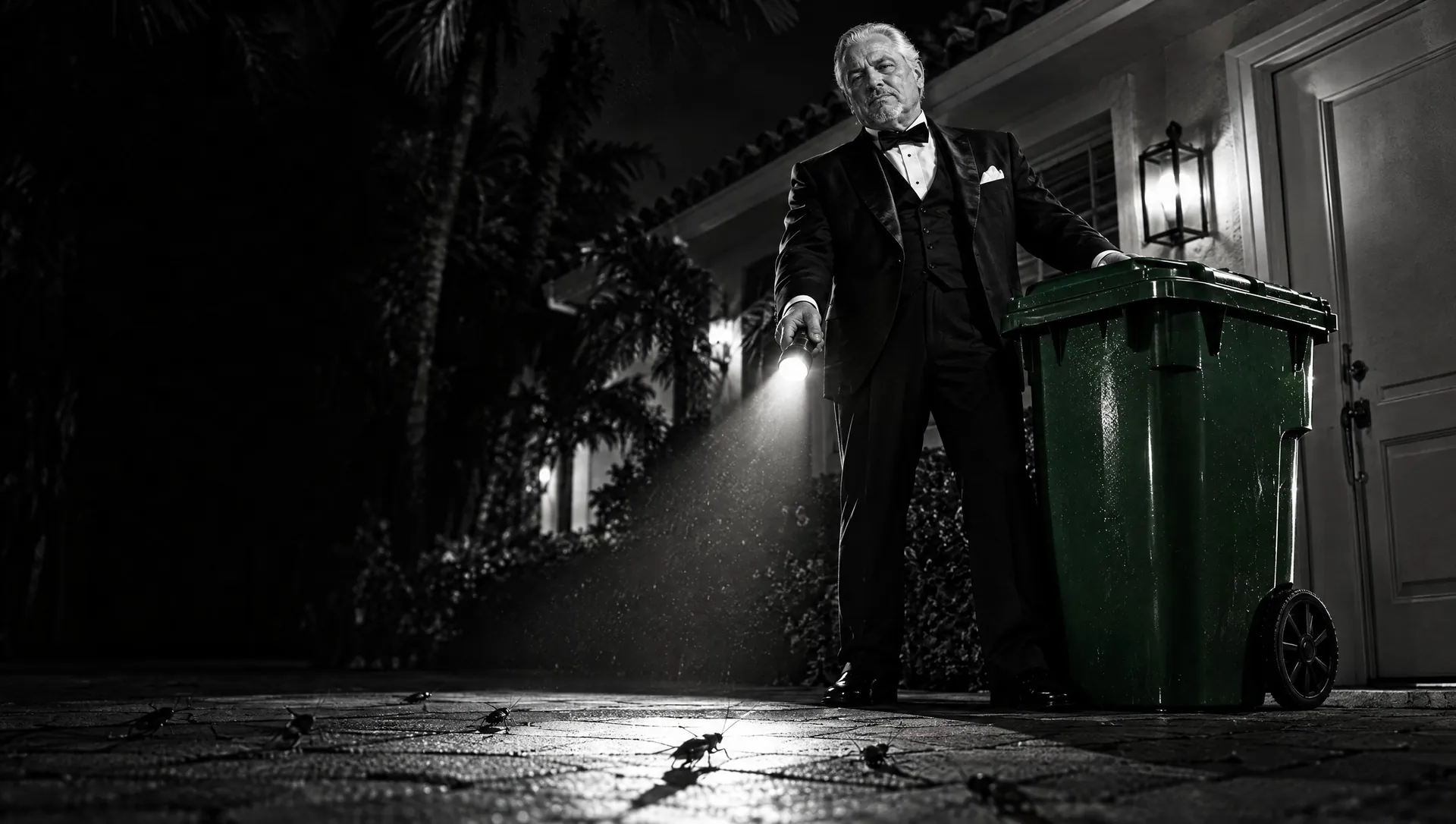

To get rid of maggots in a trash can in Florida, pour boiling water over them, scrape out the base, rinse, and let the bin dry in the sun with the lid open. That kills what you can see. To stop them coming back, the film of residue bonded to the inside wall has to be removed, because flies lay their eggs in it, not in the bag.
You lift the lid and the bottom of the bin is moving. It is unpleasant, it is common in a Florida summer, and it is fixable — but the part most people skip is the part that decides whether it happens again next week.
In this scene · 6 questions
Where do maggots in a trash can come from?
Maggots are fly larvae. A fly lands on the residue inside your cart, lays eggs directly into it, and in the heat those eggs hatch quickly — in Florida summer conditions, a batch laid on a Monday can be visible larvae by Tuesday.
That speed is why it feels like they appeared out of nowhere. They did not. The bin was ready for them, and a fly found it.
The important detail: flies lay eggs in the residue, not in the garbage bag. The bag leaves on collection day. The residue stays. That is why a bin that was emptied yesterday can still be full of maggots today.
How do you kill maggots in a trash can right now?
Boiling water kills maggots on contact, and it is the fastest way to deal with the ones you can see. If you want to handle it yourself before a proper clean, this works:
- 01Put the bin somewhere the runoff will not go into a storm drain or a flower bed — a patch of gravel or the middle of a driveway.
- 02Boiling water kills larvae on contact. A full kettle poured around the base and up the walls will take out most of what you can see.
- 03Scrape the base out with something disposable. This is the unpleasant part and there is no way around it.
- 04Rinse, then let the bin dry with the lid open in the sun for a few hours if you can.
- 05Do not use bleach as your first move. It disinfects but it does not lift the film, and you will be doing this again.
That gets you through the week. It does not solve anything.
Why do maggots keep coming back after you clean the bin?
Maggots come back because the film is still there.
Boiling water and a scrape remove the larvae and the loose material. What stays is the bonded layer of fats and sugars on the plastic wall — the same layer the flies detected in the first place. It is still there, it still smells like food to a fly from a surprising distance, and the next warm week starts the cycle again.
This is the whole reason a bin that has "been cleaned" repeatedly still gets maggots repeatedly. The cleaning removed the symptom.
What stops maggots in a trash can for good?
Strip the residue and there is nothing to lay eggs in.
That takes heat. Heated water at high pressure breaks the bond between the film and the plastic and carries it off the wall — including the base channel and the underside of the lid, which are where the worst of it collects and the two places a person with a hose never reaches properly. A deodorizing treatment then goes on afterwards, which matters because what a fly is following is smell.
A bin with no organic film on the inside is not attractive to a fly. It is just a warm plastic box.
How do you keep maggots out of a trash can in a Florida summer?
- Bag everything, and double-bag food waste. Most maggot problems start with a bag that leaked.
- Latch the lid. A closed lid is not a seal, but an open lid is an invitation.
- Never leave the bin open overnight after putting food waste in it. That is the window.
- Watch the bin, not the bag, in July and August. This is when a monthly clean earns its keep: a bin washed every month never builds the wet film that maggots need.
- Clean the recycling cart too. People assume it stays clean, but drink containers leave sugar residue that draws flies just as effectively.
What if it is not maggots?
If what you are seeing is small, fast and dark rather than pale and slow, that is more likely to be roaches, and the answer is the same: they are there for the residue. Rats and raccoons are also following smell, not sight — which is why a properly cleaned bin with a latching lid usually ends a wildlife problem that traps and sprays did not.
The short version
Maggots are a symptom. Boiling water handles today. Removing the bonded film from the inside wall is what stops it recurring, and that needs heat and pressure rather than a hose.
We clean residential carts at the curb on your collection day, after the truck has emptied them, across 43 South Florida cities. Monthly cleaning is $30 a visit and a one-time clean is $65 — both cover two bins. See the prices or book online.